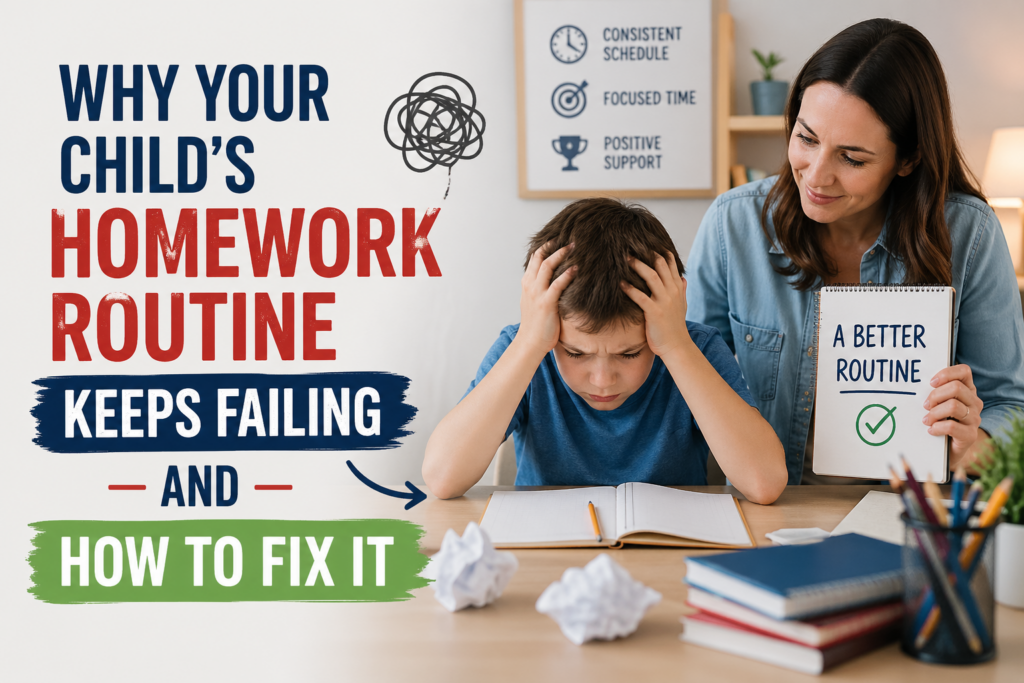
A Step-by-Step Guide for Parents | Updated 2026
It’s 7:30 PM. Dinner is cold on the table. Your child is in tears over a math worksheet. You’re exhausted from work, and somehow, the homework that was supposed to be done at 4 PM is only halfway finished — again.
Sound familiar?
You’re not alone. Millions of American parents struggle with the same nightly homework battle. And the frustrating truth is: it’s rarely about laziness or lack of effort. Most of the time, the homework routine itself is broken — not your child.
The good news? With a few small but intentional changes, you can build a homework routine that actually sticks. No more nagging. No more meltdowns. No more 9 PM panic sessions.
Let’s fix this, step by step.
Why Most Homework Routines Fail
Before we build something better, it helps to understand why the current system keeps breaking down. Here are the most common reasons:
- No consistent time or place. When homework happens “whenever,” kids’ brains never shift into focus mode automatically.
- Starting too soon after school. Kids are mentally drained after 6+ hours of learning. Jumping straight into homework backfires.
- Too many distractions. Phones, TVs, siblings, and snack runs all chip away at focus.
- Parents enforcing but not guiding. Saying “go do your homework” without a clear system leaves kids feeling lost and resistant.
- No sense of reward. If homework leads to nothing but more chores or bedtime, kids have zero motivation to get it done.
Recognizing these patterns is the first step. Now let’s replace them with something that works.
The 5 Building Blocks of a Homework Routine That Sticks
1. 🕓 Set a Consistent Start Time
The single most powerful thing you can do is pick a homework start time — and protect it every day.
The sweet spot for most kids? 30 to 60 minutes after school ends. This gives them just enough time to decompress without fully switching off their academic brain.
Avoid starting too late (after dinner, kids are mentally done) or too early (right off the bus, they need a moment to breathe).
Pro tip: Put the homework time on a visible family calendar or whiteboard. When kids see it as a fixed part of the day — like dinner or bedtime — they stop negotiating it.
2. 📍 Create a Dedicated Homework Space
Where your child does homework matters almost as much as when.
The ideal homework spot is:
- Quiet — away from the TV and high-traffic areas
- Consistent — the same place every single day
- Stocked — pencils, erasers, paper, and any supplies already there (no excuses to wander)
- Comfortable but not too cozy — a bed is a nap trap; a desk or kitchen table works better
You don’t need a fancy setup. A cleared kitchen table or a small desk in their room is perfect. The key is that when your child sits there, their brain knows: this is work time.
3. 🧠 Start With a Brain Break — Not Homework
This one surprises many parents, but it works.
After school, your child’s brain needs a short reset before it can focus again. Instead of forcing them straight to the desk, build in 15 minutes of downtime first — a snack, some outdoor time, or quiet play.
This isn’t procrastination. It’s science. Short breaks after sustained mental effort help the brain consolidate information and refuel for the next session.
After the break, transition into homework with a simple cue — like a timer going off or a specific snack that signals “work time.” Routines built on small rituals become automatic faster.
4. 📋 Use a Simple Planner or Checklist
Kids — especially younger ones — work much better when they can see what needs to be done and cross things off.
Help your child build a quick daily checklist at the start of homework time:
- List every assignment
- Estimate how long each will take
- Decide the order (hardest first works well for most kids)
- Check off as they go
For younger kids, a colorful paper chart with sticker rewards works beautifully. For older kids, a simple planner notebook or a free app like Todoist does the job.
The act of checking things off gives a small dopamine hit — which keeps motivation going through the session.
5. 🏆 Build In a Small Reward
Every good routine has a finish line.
Let your child know what they’re working toward. It doesn’t have to be big — even small rewards are powerful motivators:
- 30 minutes of screen time
- A favorite snack
- Time to play outside
- Choosing what’s for dinner
The key is that the reward comes after homework is fully complete — not during. This gives kids a reason to stay focused and push through the tough parts.
Over time, the sense of accomplishment itself becomes its own reward. But in the early weeks, a little external motivation goes a long way.
How to Customize the Routine by Age
Not all kids are the same, and a good routine grows with your child.
Ages 5–8: Short, Structured, and Parent-Led
- Keep sessions to 20–25 minutes with short breaks in between
- Sit nearby and offer gentle help — this age needs guidance, not independence
- Use colorful charts, stickers, and visual timers to keep things fun
- Celebrate completion with enthusiasm — their motivation comes from your approval
Ages 9–12: Building Independence
- Extend sessions to 30–45 minutes
- Teach them to write their own checklist and estimate their time
- Check in at the start and end, but resist hovering in the middle
- Let them make small decisions — like choosing assignment order — to build ownership
Ages 13 and Up: Step Back and Let Them Lead
- Teens need to own their routine completely — your job shifts to accountability
- Have a weekly check-in conversation instead of daily monitoring
- Let natural consequences (a low grade) teach the lesson if they slip — it works better than nagging
- Stay available, but don’t rescue them every time they feel overwhelmed
What to Do When the Routine Breaks Down
Every routine hits bumps. Here’s how to handle them without starting from scratch:
If there’s resistance: Don’t punish — get curious. Ask “What part feels hard right now?” You might discover the homework load is too heavy, something at school is bothering them, or they’re just exhausted.
If the schedule falls apart: Adjust one variable at a time. Move the start time 15 minutes earlier, or switch the homework location. Small tweaks beat complete overhauls.
If the workload feels unreasonable: Reach out to the teacher. Many US schools have homework guidelines, and teachers often don’t realize the total load across all subjects. A short email can make a real difference.
If nothing is working: Talk to your child’s school counselor. Sometimes homework struggles point to learning differences, anxiety, or social stress that need professional support.
Helpful Tools and Apps
You don’t need to do this alone. These tools can support your child’s homework routine:
- Forest App — A focus timer that “grows a tree” while your child works. Using the phone kills the tree. Kids love it.
- Todoist or Google Tasks — Simple, free task lists for older kids to track assignments
- Notion — Great for middle and high schoolers who want to organize everything in one place
- A paper planner — Don’t underestimate this. For many kids, writing by hand creates stronger commitment than typing
- A visual timer (like Time Timer) — Perfect for younger kids who can’t read a clock yet
Final Thoughts: Give It Time
Building a new habit takes time. Research suggests it takes anywhere from 2 to 4 weeks of consistent repetition before a routine becomes automatic. So if your child pushes back in week one — that’s normal. Stay calm, stay consistent, and keep the routine in place.
You’re not looking for a perfect homework session every night. You’re building a system that makes good work habits feel normal over time. And that investment pays off for years to come — through high school, college, and beyond.
Here’s a quick recap of the 5 building blocks:
- ✅ Set a consistent start time (30–60 mins after school)
- ✅ Create a dedicated homework space
- ✅ Start with a 15-minute brain break
- ✅ Use a checklist or planner
- ✅ Build in a small reward for finishing
Which tip are you going to try first? Drop a comment below — we’d love to hear how it goes for your family!
Found this helpful? Share it with a fellow parent who needs it. 💛